
How We Spot Arm Pain in Throwers in 3 Seconds
Oct 15, 2026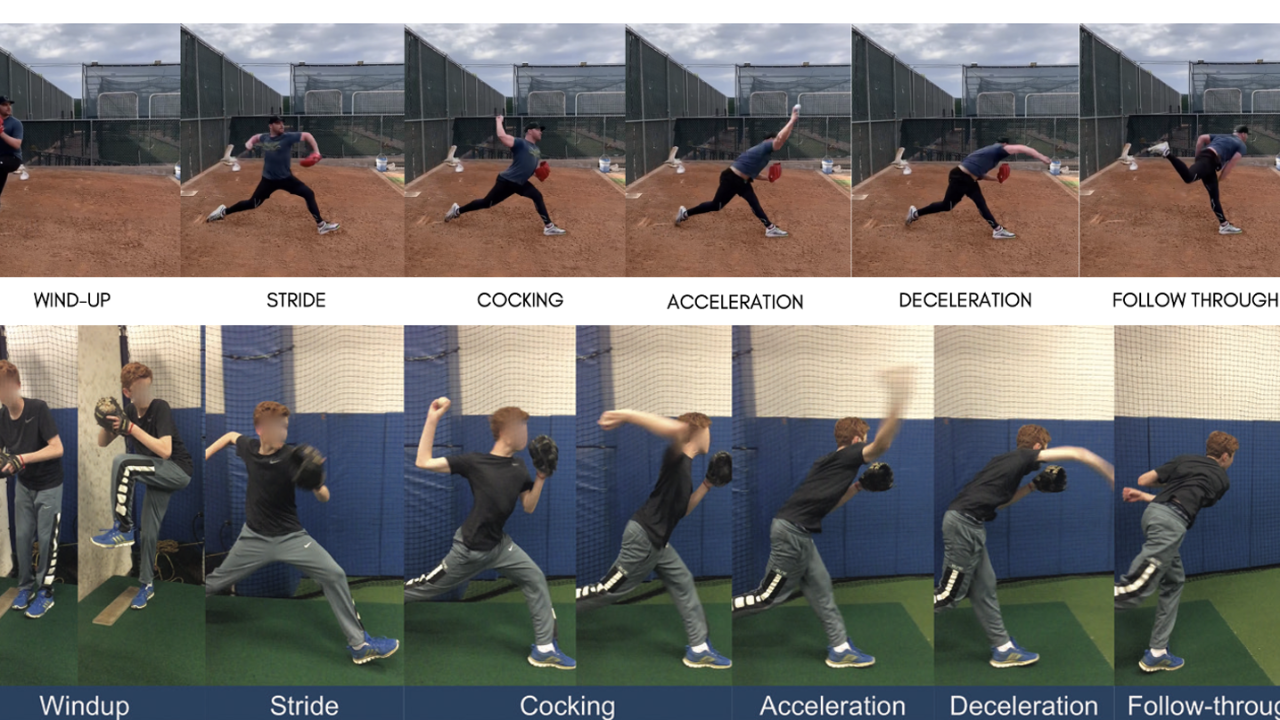
Throwing is broken down into six distinct phases – think of these as checkpoints that every thrower needs to achieve to make an optimal throw.
By looking at each of these, we can see if a thrower is hitting a checkpoint effectively or if they're below where they need to be in terms of either range of movement, movement pattern or timing.
The six phases are:
- Wind-up
- Stride
- Early and late cocking (also known as layback)
- Acceleration
- Deceleration
- Follow-through
By simply viewing a short video, we can slowly scroll through each of these phases to better understand what checkpoints the thrower is achieving or missing.
There are three main phases where we are looking for a particular expression of movement.
The stride phase should be marked by adequate rear hip flexor mobility and front adductor mobility. Failure to do this means that, with a reduced stride, the force that was being transferred from the ground up to the arm has now been inhibited, leading to greater forces being absorbed at the shoulder or elbow.
In the early and late cocking phase, we’re looking to see if a player can achieve full external rotation of the shoulder.
We also want to see if they get their trunk into a position that allows for a quality release of the ball, before the arm progresses to follow-through.
In a lot of younger players, we see the legs not doing enough and the trunk not getting into the right positions, which results in the arm having to overwork. This leads to excessive stress loads and forces through the shoulder and elbow, and a high chance of the player breaking down at some point during the season.
The last is follow-through. Again, in younger players, many stay up very tall when they throw. So rather than their trunk doing the follow-through, the shoulder is forced to do an excessive follow-through, leading to high loads in the back of the shoulder and stress in the posterior rotator cuff. Stress that otherwise should have been absorbed by the trunk as it followed through.
Because we see these deficits all the time, we can implement solutions with high clinical confidence that they will improve the number.
We built a short program to help you learn more about your throwing pattern, and you can do it in the comfort of your own home.
Check out The Throwing Sequence and Movement Screen and, as always, let us know how you get on.
Keep working,
Josh and Jason